

• Project
  • Opportunities

The Initial Capital

Published
December 8, 2025
Status
ongoing
Background

In Germany, social mobility is still strongly shaped by family background. Children from wealthy families benefit from savings, educational support, and knowledge about how to manage money. Those who lack these advantages start out at a disadvantage that is difficult to overcome, even with great personal effort. Our latest survey data show that the vast majority of people want social mobility to depend more on individual achievement and for young people to have equal starting opportunities. At the same time, trust in the promise of merit is declining: many citizens doubt that hard work truly pays off when starting conditions are so unequal.

To restore this trust, we need approaches that go beyond short-term redistribution and focus instead on long-term empowerment. Investing in young people is therefore also an investment in society as a whole. Financial education improves decision-making, helps prevent excessive debt, encourages entrepreneurship, and contributes to sustainable prosperity. In an increasingly complex world, it becomes a key skill—enabling people to understand risks, recognize opportunities, and make informed choices, whether in career decisions, saving, or sustainable investing.

Motivation

Equal opportunity begins earlier than the point at which the welfare state’s reactive transfer payments take effect. From early childhood onward, it is shaped by whether we learn how to manage money—and whether any capital is available at all to build something over time. Education alone is not enough if the material foundation is missing. Conversely, money only reaches its full potential when people have the knowledge to use it wisely.

Financial education and early material support must work together so that family background has less influence on life trajectories.

Especially in Germany, there is significant catching up to do. Many young people leave school without ever having learned about investing, insurance, or debt management.

The welfare state must move beyond constant reaction and instead focus on proactive empowerment. Through financial education and initial capital, Initial Capital creates genuine opportunities for people to take social mobility into their own hands.

Moritz Rüppel – Project Lead and Head of Policy Unit

Concept

One solution is Initial Capital: the state provides a capital-funded investment account for each child, which is transferred into their own management upon reaching adulthood.

This requires proof of financial education through a standardized financial literacy certificate. Without this personal commitment, the funds remain in managed custody and are only paid out upon retirement—similar to the planned early-start pension scheme.

Initial Capital views the state as an enabler that not only reacts to disadvantages but proactively creates opportunities while also fostering personal responsibility.

The goal is to promote financial skills and individual wealth building. If this empowerment can be achieved broadly, it can restore waning confidence in the promise of upward mobility and strengthen social mobility.

Publications

  • Policy Brief
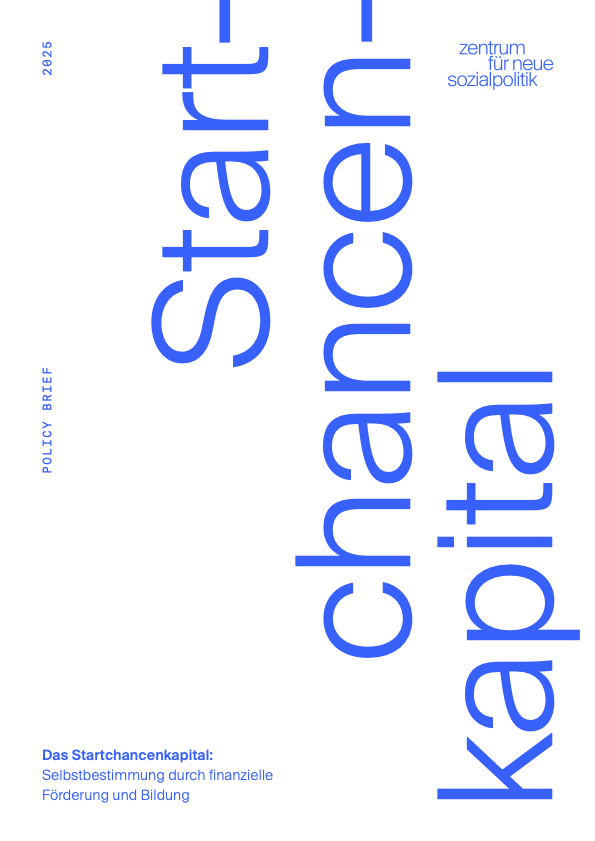
Das Startchancenkapital

Viele Menschen starten mit unzureichenden Chancen ins Leben. Das Startchancenkapital verbindet finanzielle Starthilfe mit praxisnaher Finanzbildung und legt für jedes Kind ein kapitalmarktbasiertes Konto an. Nach dem Erwerb grundlegender Finanzkenntnisse wird das Guthaben mit Volljährigkeit als Wertpapierdepot übergeben – so eröffnet das Programm Perspektiven, stärkt Eigenverantwortung und fördert sozialen Aufstieg.

Read now

Team

Moritz Rüppel

Leitung Fachbereich

Moritz Rüppel leitet den Bereich Zukunftsfähiger Sozialstaat. Im Fokus seiner Arbeit steht die politisch-strategische Ausrichtung des Bereichs, die proaktive Themensetzung der dort bearbeiteten Inhalte und der Transfer der Forschungsergebnisse in den parlamentarischen und vorpolitischen Raum.